
The 5 Friction Points in Professional Trading
In professional trading, most losses don’t come from bad ideas. They often come from friction – the kind you don’t see on a P&L until it’s too late.
Think of it as the plumbing. The path a trade takes from order entry to execution to clearing.
Retail platforms often tend to focus on slick interfaces and “free” trades. Institutional trading is different.
The focus is resilience: what happens when markets move fast, systems hiccup, or something unexpected breaks?
At Gar Wood Securities, we spend a lot of time thinking about where things actually go wrong. These are the five friction points we deliberately manage so infrastructure supports the trader instead of getting in the way.
1. Human-in-the-Loop Support
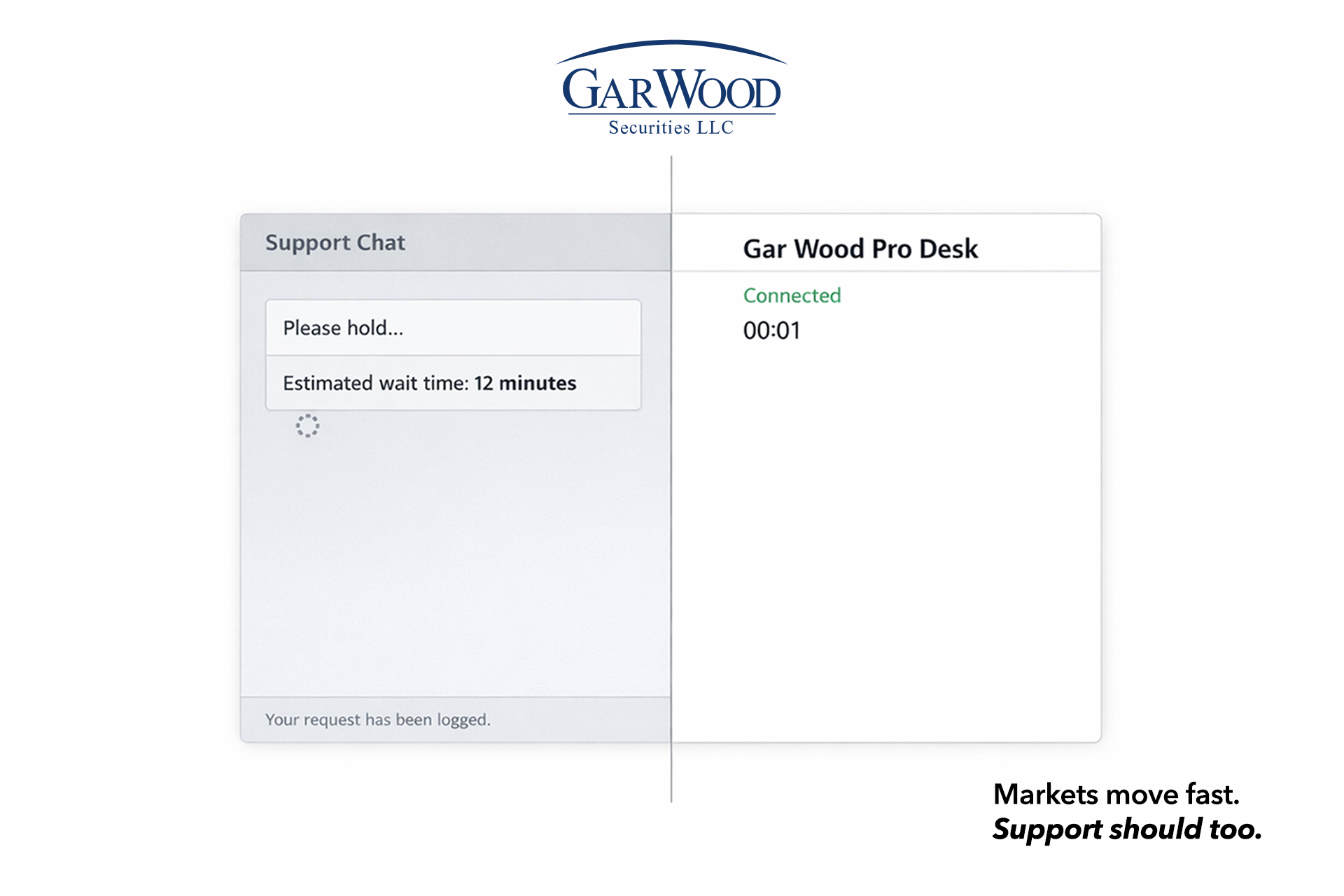
Technology works great, until it doesn’t. And when it fails during a volatile market, the biggest risk often isn’t the position itself, it’s being stuck in a support queue
That’s why our Pro Desk operates on a direct-access model. During market hours, clients aren’t dealing with chatbots, tickets, or escalation chains. They’re speaking directly with licensed professionals who understand both the technology and the trade.
When something breaks, speed and judgment matter more than automation.
2. The Agency-Only Structural Guardrail
Conflicts of interest aren’t always obvious, but they’re very real in brokerage.
Many firms operate proprietary trading desks alongside client flow, which means the broker can effectively be competing with the trader. That’s a structural risk, not a hypothetical one.
Gar Wood is an agency-only broker. We do not trade against our clients. That choice is intentional. It ensures that routing decisions, execution oversight, and desk support are aligned with client outcomes, full stop.
3. Institutional Routing vs. “Free” Trades
The zero-commission retail model is built on Payment for Order Flow. While it lowers the visible cost of a trade, it often introduces invisible costs through routing and spread capture.
Our focus is Direct Market Access. Orders are routed to the most liquid venues with the goal of price improvement, not rebates. For active and high-volume traders, what matters isn’t the commission line, it’s the total cost of execution.
Over time, slippage matters more than marketing.
4. Qualitative Risk Management
Most modern risk systems are automated by design, and for good reason. Speed and consistency matter, especially in fast-moving markets.
The risk comes when automation is the only layer. Binary, rules-based liquidations don’t account for context, and can force exits at the worst possible moment during a temporary spike or dislocation.
For established accounts, we take a layered approach. Risk parameters are enforced programmatically, but reviewed by experienced professionals who understand portfolio structure, market conditions, and timing before a machine forces an exit.
It’s not about replacing automation. It’s about knowing when human judgment should complement it.
5. Technical Onboarding & Migration
For many professional traders, switching firms isn’t just opening a new account. It’s migrating an entire ecosystem: APIs, scripts, custom workflows, platforms like DAS or Sterling.
That complexity creates inertia, and inertia keeps people stuck at firms that no longer serve them well.
We treat onboarding as a technical project, not paperwork. Our concierge process helps with platform setup, API mapping, testing, and validation so the environment is fully dialed in before the first trade ever goes live.